
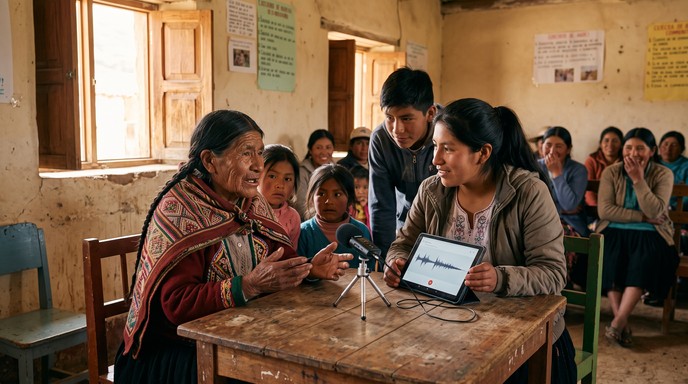
Oral History Projects
When I first captured oral histories, I considered only immediate family members. While that was a good place to start, in 2008 I learned about the Library of Congress American Folklife Center Veteran’s History Project.
Participating in the Veterans History Project
I became familiar with the Veterans History Project requirements and forms and worked with a local coordinator who provided names of potential interviewees. However, my first two interviews were with Smitty and George, WWII veterans whom I knew well enough at church to say “hi.”
After inquiring if I could interview them, I asked each man for some basic information about their military service. Then I did a lot of homework to prepare specific interview questions for each man and to prepare myself for on-the-fly follow-up questions.
In my interview session with Smitty, I learned the importance of keeping the Panama Canal open for the movement of naval fleets between the Atlantic and Pacific oceans. I also learned Smitty had served on the staff of General MacArthur and of Admiral Nimetz. When Smitty took a breath, I asked him what he thought of these two military leaders. In Smitty’s estimation, General MacArthur was a prince, and Admiral Nimetz was the shrewdest man he’d ever met.
In my initial session with George, I learned he’d been a tail gunner on a B-15 with the 15th Air Force in Italy. He had flown 18 combat missions and 2 food-drop missions. After WWII, George had also worked at the Atomic Energy Commission and a national lab. One of the science projects to which he’d contributed was still circling the sun. I later met with George several times and chatted with him about his progress gathering additional documents that detailed his experiences and his experiments. These additional materials included photos, newspaper clippings, and unclassified documents to submit to the Veteran’s History Project. He also made copies of the oral interview and all his additional materials and put them in a three-ring binder, which he kept. George and I became good friends. George has since passed, but before he did, he passed on his binder, along with a copy of his oral interview, to his children and grandchildren.
In a year’s time, I was fortunate enough to interview six additional veterans, including a neighbor and five veterans whom I’d never met before. Interwoven in each was a testimony and tribute to their comrades in arms. They each were willing to provide current and future generations a glimpse into the historical context of bygone days. I felt honored that each veteran trusted me with his story.
Broadening the spectrum of possibilities
Later, I learned that the Veterans History Project is just one of many oral history projects of the Library of Congress. The breadth and depth of oral history projects worldwide amazed me.
I learned about oral history projects associated with national, regional or local government entities. Libraries, museums, and archives. Educational institutions including public and private elementary and secondary schools and colleges and universities. And institutions, associations, and organizations.
An oral history project may focus on a specific time period or a location. It may emphasize an occupation or experience. It might be connected with a genealogy or historical society, or a genealogy website.
Considering where you might share the oral histories you’re collecting
Perhaps the individual you hope to interview is willing to share their story with a larger audience. If so, the Boston Public Library suggests searching for possibilities that are good fits and contacting the organization(s) early in your interviewing process. They also note that each organization may require that you structure interviews in a certain format and/or include specific information and signed permissions. They may also require specific training, equipment, time limits, and forms.[1]
If you want to share your oral histories with others beyond your family circle, below is a smattering of oral history collections to kick-start your brainstorming session. Some but not all are centered in the United States, but please look for projects associated with other nations if appropriate to your project. Some focused on one oral history project, while others contain numerous oral history projects including some subsets of a project.
- 9/11 Memorial & Museum [2]
- Ancestry[3]
- Archive of Native American Recorded History[4]
- Association for Diplomatic Studies and Training Oral History Archive[5]
- Buncombe County (North Carolina) Special Collections[6]
- Columbia Center for Oral History Research[7]
- Digital Public Library of America[8]
- FamilySearch[9]
- Fordham University: Bronx African American History Project[10]
- The Foundation for Advancement in Conservation[11]
- Harvard Library[12]
- Internet Archive[13] (E.g., National Park Service—Pearl Harbor National Memorial Oral History Project[14])
- Library of Congress[15] (E.g. Civil Rights History Project[16]; Navajo Code Talkers: A Guide to First-Person Narratives in the Veterans History Project[17]; Occupational Folklife Project[18]; and Voices Remembering Slavery[19])
- National Library of Medicine[20]
- National Park Service[21]
- Naval History and Heritage Command[22]
- Occidental College Library[23]
- Oklahoma State University Edmon Low Library[24]
- Rutgers University Libraries[25]
- Science History Institute Museum & Library[26]
- Smith College Libraries[27]
- StoryCorps[28] (E.g., “The Great Thanksgiving Listen” and “Memory Loss Initiative”)
- United States Holocaust Memorial Museum[29]
- United States Senate Oral History Project[30]
- The National World War II Museum[31]
Although written and printed documents are my favorite long-term format for family stories and histories, oral histories also have a place in saving and sharing our heritage.
- Which oral history projects and collections have you contributed oral histories to?
- Which oral history projects would you like to contact to see if the oral history you want to record fits into their collection?
- Which other projects or collections are you aware of that others might want to contribute their oral histories to?
[1] Boston Public Library, Research Guides, “Donating Your Project” (https://guides.bpl.org/OralHistory/share).
[2] 9/11 Memorial & Museum, Oral Histories (https://www.911memorial.org/learn/resources/oral-histories).
[3] Ancestry; Search; Stories, Memories & Histories; Oral Histories & Interviews (https://www.ancestry.com/search/categories/flh_oral).
[4] Archive of Native American Recorded History (https://www.nativeoralhistory.org).
[5] Association for Diplomatic Studies and Training, Oral Histories (https://adst.org/oral-history/).
[6] Buncombe County Special Collections, Oral History Resources (https://specialcollections.buncombenc.gov/oralhistory/).
[7] Incite/Columbia Center for Oral History Research, Projects (https://www.ccohr.incite.columbia.edu/research).
[8] Digital Public Library of America, Guides, The Family Research Guide to DPLA (https://dp.la/guides/for-family-research-guide-to-dpla).
[9] FamilySearch, Memories, Capture family history as it happens (https://www.familysearch.org/en/memories/).
[10] Fordham University, Research, Libraries and Collections, Bronx African American History Project (https://www.fordham.edu/academics/research/libraries-and-collections/bronx-african-american-history-project/).
[11] Winterthur Museum, Garden & Library; Collections, FAIC (Foundation for Advancement of Conservation) Oral History Project Collection (https://digitalcollections.winterthur.org/collections/faic-oral-history-project-1).
[12] Harvard Library, Research Guides, Oral History Research (https://guides.library.harvard.edu/oralhistoryresearch).
[13] Internet Archive, Search “Oral History Projects” (https://archive.org/search?tab=audio&query=oral+history+projects).
[14] Internet Archive, Pearl Harbor National Memorial Oral History Project (https://archive.org/details/Pearl-Harbor-National-Memorial-Oral-History-Project).
[15] Library of Congress, Digital Collections, Personal Narratives, Personal Narratives, Oral History Projects, Search Collections (https://www.loc.gov/collections/?q=oral+history+projects).
[16] Library of Congress, Digital Collections, Civil Rights History Project (https://www.loc.gov/collections/civil-rights-history-project/about-this-collection/).
[17] Library of Congress, Research Guides, Veterans History Project, Navajo Cole Talkers: A Guide to First-Person Narratives in the Veterans History Project (https://guides.loc.gov/navajo-code-talkers/profiles).
[18] Library of Congress, Digital Collections, Occupational Folklife Project (https://www.loc.gov/collections/occupational-folklife-project/about-this-collection?loclr=blogloc).
[19] Library of Congress, Digital Collections, Voices Remembering Slavery: Freed People Tell Their Stories (https://www.loc.gov/collections/voices-remembering-slavery/about-this-collection/).
[20] National Institutes of Health, National Library of Medicine, Archives & Modern Manuscripts, Oral Histories (https://www.nlm.nih.gov/hmd/manuscripts/oh.html).
[21] National Park Service, Oral History (https://www.nps.gov/subjects/oralhistory/index.htm).
[22] Naval History and Heritage Command, Archives, Collections, Oral History Collections (https://www.history.navy.mil/research/archives/Collections/oral-histories.html).
[23] Occidental College, Archives and Archival Resources: Oral Histories (https://libguides.oxy.edu/archives/oral-histories).
[24] Oklahoma State University, Edmon Low Library & Branch Libraries, Oral History Collections (https://library-dep.okstate.edu/oralhistory/our-collections/digital/).
[25] Rutgers University Libraries, Research Guides, Oral History: Resources and Archives: Home (https://libguides.rutgers.edu/oralhistory).
[26] Science History Institute Museum & Library, Digital Collections, Oral History Collection (https://digital.sciencehistory.org/collections/gt54kn818).
[27] Smith College Libraries, Oral Histories Special Collections Resources: Collections at Smith (https://libguides.smith.edu/scsc-oral-histories/collections).
[28] StoryCorps, Programs (https://storycorps.org/discover/).
[29] United States Holocaust Memorial Museum, About the Museum’s Collections, Oral History (https://www.ushmm.org/collections/the-museums-collections/about/oral-history).
[30] United States Senate, Home, About, Oral History Project (https://www.senate.gov/history/oralhistory.htm).
[31] The National WWII Museum, Oral History Resources: Oral History Guidelines and Resources, Search “Oral History Collection” (https://www.nationalww2museum.org/oral-history-resources).
I love StoryCorp so much…and it often makes me cry, mostly happy tears.
What a wonderful, informative, and inspiring article re. oral histories! I am an avid fan of NPR’s Story Corp aired on our local station every Friday. For me, a person’s vocal inflection paints a vivid picture of the person being interviewed, and their word choice, regional accent, colloquial expressions, and underlying emotions sharpen that image.
Thank you for the nudge of possibility and step-by-step examples of how to make the most of oral history interviews!